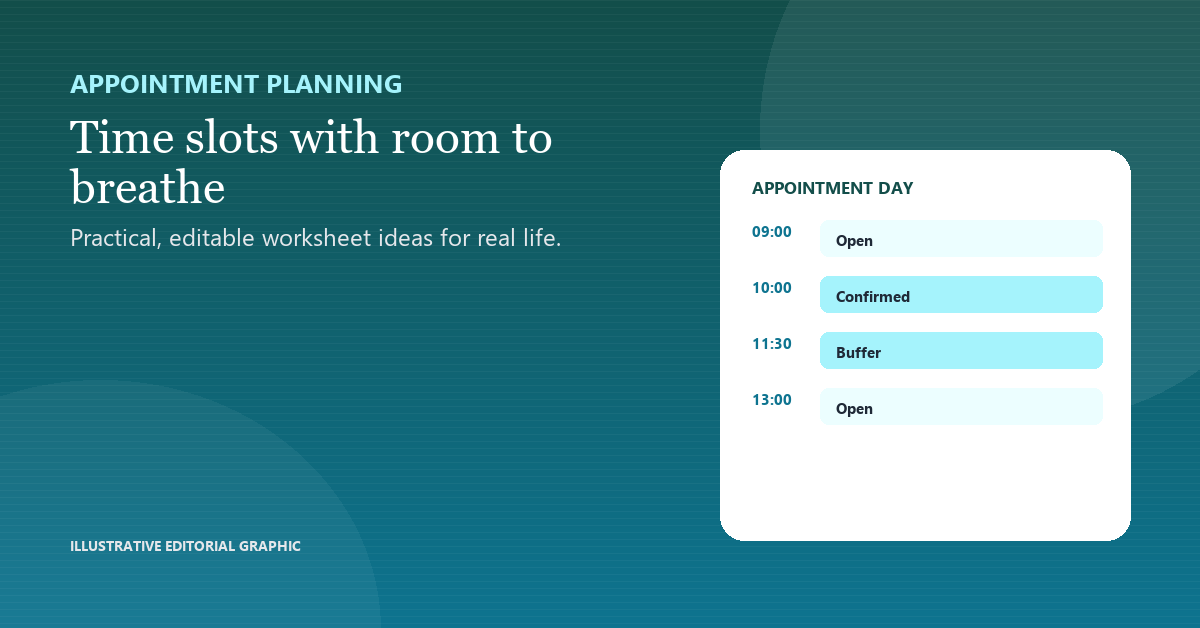
Most scheduling problems are design problems. The calendar often allows less time than the service actually needs, leaving too little room for notes, transitions or delays.
Mistake 1: booking back-to-back
Without a buffer, one late appointment moves every later one. Add a visible gap after overrun risks.
Mistake 2: using the best-case duration
A service length that only works on an easy day is not a plan. Measure setup, service and close-down separately.
Mistake 3: no written policy
Clients cannot follow a rule they have not seen. Put the late/no-show policy where booking happens.
Mistake 4: notes at the end of the day
Notes become a backlog and details blur. Block a short admin slot after the appointment.
Mistake 5: no daily review
Without comparing planned and actual time, the same unrealistic schedule repeats. Review one slot length each week.
A quick repair
| Item | Example |
|---|---|
| Symptom | Repair |
| Always running late | Add one buffer |
| Notes piling up | Block admin time |
| No-shows repeat | Write the policy |
What to watch for
- Filling a gap simply because it exists.
- Treating a no-show as a personal failure instead of a process issue.
- Changing the schedule every day without measuring it.
A useful next step
Pick one repair and keep it for a week. A small schedule change that is measured is more useful than a complete redesign. If the day has three back-to-back appointments, add one buffer after the middle one first. Check the next day’s first two slots before leaving; that is where a late finish usually causes the most damage. Leave ten minutes between the last two appointments. Check the calendar for a late finish before adding the first booking on the following day. Name the buffer on the calendar so it is not treated as free time.